
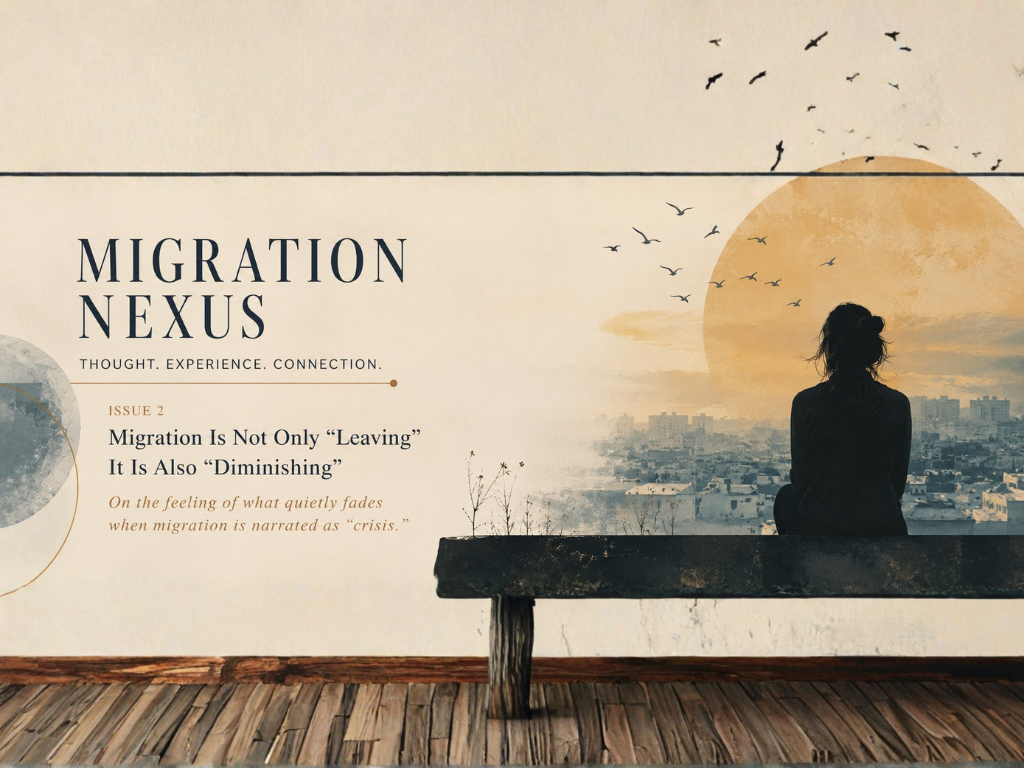
On the feeling of what quietly fades when migration is narrated as “crisis.”
Migration has not been spoken about, for a long time now, merely as people moving from one place to another. In public discourse, migration is often constructed as a matter of governance, a border regime, a security imagination and increasingly, as a crisis narrative. The “migration as crisis” literature captures this precisely: the coupling of migration and crisis is not always a self-evident outcome of events, but a political frame that is produced in specific contexts and then shapes how migration is governed (Cantat et al., 2023).
And at the center of this narrative willingly or not stands IOM. Today IOM is widely referred to as the UN Migration Agency. Its shift in 2016 into the UN system as a related organization made its role in global migration governance even more visible (International Organization for Migration, 2016; Bradley, 2020; Pécoud, 2018). Research that examines how IOM has promoted and recast the language of safe, orderly and regular migration suggests something important: migration language is not only descriptive; it is also directive it steers what becomes thinkable, manageable, and legitimate (Panizzon & Jurt, 2023; Dini et al., 2025). This is also why the seemingly simple question “Who is a migrant?” remains conceptually and politically contested (Bartram et al., 2014; Tsegay, 2023).
Still, if we step back to the level of definitions, migration’s core is very concrete. One widely used IOM definition describes migration as the movement of persons away from their place of usual residence either across an international border or within a state (IOM, n.d.). A similar phrasing appears in academic reference works: “movement of persons away from their place of usual residence…” (ten Have & Patrão Neves, 2021). Yet definitions do not always capture what migration leaves behind inside the person. Because migration changes the rhythm of life before it changes geography. And this is why I sometimes think of migration not only as “leaving,” but as diminishing.
By diminishing, I do not mean a clean break. I mean something that becomes smaller over time, something that fades and, sometimes, something whose absence becomes suddenly undeniable. English is helpful here, because the verbs map the feeling with precision: diminish to become smaller or weaker (Oxford Learner’s Dictionaries); fade to slowly disappear or lose intensity (Cambridge Learner’s Dictionary, n.d.-a); and at times vanish to disappear suddenly (Cambridge Learner’s Dictionary). In migration, “diminishing” often moves between these three: some things weaken, some things slowly fade, and some things are simply gone one day you notice, and that is all.
You leave, and life continues. The city wakes up with the same sounds; the streets fill with the same rhythm. People meet, talk, laugh, argue. The world does not pause for your absence. And yet something happens. Something shifts with you. Sometimes a habit, sometimes a shared language between you and another person, sometimes a version of you that existed there. This loss rarely looks like a single event; it does not snap in one moment. It loosens, slowly. And perhaps that is why certain parts of migration hurt most later not at the beginning, but as time accumulates.
The hardest part of diminishing is often the lack of closure. There are losses that cannot fit into a goodbye. Not only people, but the small evidence of life also disappears. A message thread grows quieter; the jokes inside a group stop returning to you; someone speaks about you in the past tense without even noticing. No one said, “Let’s end this.” No one intended harm. And yet there is something like the normalization of absence and that is what exhausts you most: you can sense what is happening, but you cannot stop it; you cannot even fully choose what, exactly, you are grieving.
This is where the concept of ambiguous loss becomes illuminating. Pauline Boss describes losses that are real but unresolved losses whose boundaries remain unclear making it difficult for the mind to “complete” the experience and move on (Boss, 1999, 2006). In migration, this feels deeply familiar: a relationship has not ended, but it is no longer what it was; a place still exists, but its place in your life has changed; certain bonds have not broken, but they are no longer alive in the same way. When something continues to exist while also slowly fading, it produces a particular kind of fatigue.
Then you arrive somewhere new, and another tension begins: for a while, you remain strangely stable. Inside, you carry yourself as the same person with the same memory, the same reflexes, the same humor, the same tiredness. The self feels as if it traveled intact. But the world around you does not recognize you yet. Your past is invisible here. Few people know you. The familiarity you once had with a place the tone of your greeting, the unspoken rules of when to speak and when to pause, what a glance means is absent. And so you begin to feel something like this: I am the same, but nothing confirms me; I have a place, and yet I do not.
Parts of the acculturation literature describe this through acculturative stress: the effort of adapting to new norms, language, and social codes can strain one’s internal equilibrium, especially in the early period (Berry, 1997). This does not always feel like “I changed.” It often feels like “my surroundings changed, and I am still trying to carry myself through it.” Some days, the exhaustion comes not from learning something new, but from constantly adjusting.
At that point, migration stops being only about moving and becomes about rebuilding social ties. Classic findings in psychology have long emphasized that social support can buffer the effects of stress and strengthen one’s capacity to cope (Cohen & Wills, 1985). And the need to belong is widely treated as a fundamental human motivation: people need a network in which they are recognized and accepted (Baumeister & Leary, 1995). What is difficult in migration is not always the new city; it is building a new witnessing network of people who see you, know you, remember you, and hold some continuity of who you are. Because sometimes what keeps a person afloat is not the ability to explain themselves, but the rare relief of being understood without explanation.
This is why migration, even when it is framed primarily as a border issue, is also a question of continuity. Where does the continuity of life break? Which ties withstand distance, and which do not? What kinds of evidence make a person feel like the “same self”? These questions may sound personal, but they are also social because migration reshapes not only the migrant’s life, but also what those who remain call “we.” Diminishing does not happen only in the person who leaves; something also diminishes there. Small rituals disappear. Certain relationships thin out on their own. Some places grow quiet. Migration often works like this: a visible beginning on the surface, and a quiet diminishing underneath.
I want to end with a question: Have you ever lost something without realizing you were losing it until one day you noticed it was gone? Maybe a person. Maybe a place. Maybe a version of yourself. In Migration Nexus, I want to follow these questions without rushing.
References
Baumeister, R. F., & Leary, M. R. (1995). The need to belong: Desire for interpersonal attachments as a fundamental human motivation. Psychological Bulletin, 117(3), 497–529. https://doi.org/10.1037/0033-2909.117.3.497
Bartram, D., Poros, M. V., & Monforte, P. (2014). Key concepts in migration. SAGE. https://doi.org/10.4135/9781473921061
Berry, J. W. (1997). Immigration, acculturation, and adaptation. Applied Psychology: An International Review, 46(1), 5–34. https://doi.org/10.1111/j.1464-0597.1997.tb01087.x
Boss, P. (1999). Ambiguous loss: Learning to live with unresolved grief. Harvard University Press.
Boss, P. (2006). Loss, trauma, and resilience: Therapeutic work with ambiguous loss. W. W. Norton.
Bradley, M. (2020). The international organization for migration: Challenges, commitments, complexities. Routledge. https://doi.org/10.4324/9781315744896
Cambridge Learner’s Dictionary. (n.d.-a). Fade. Cambridge University Press. Retrieved May 11, 2026, from https://dictionary.cambridge.org/dictionary/learner-english/fade
Cambridge Learner’s Dictionary. (n.d.-b). Vanish. Cambridge University Press. Retrieved May 11, 2026, from https://dictionary.cambridge.org/dictionary/learner-english/vanish
Cantat, C., Pécoud, A., & Thiollet, H. (2023). Migration as crisis. American Behavioral Scientist, 69(6), 627–649. https://doi.org/10.1177/00027642231182889
Cohen, S., & Wills, T. A. (1985). Stress, social support, and the buffering hypothesis. Psychological Bulletin, 98(2), 310–357. https://doi.org/10.1037/0033-2909.98.2.310
Dini, S., Fine, S., & Pécoud, A. (2025). Rethinking the International Organization for Migration. Geopolitics. Advance online publication. https://doi.org/10.1080/14650045.2025.2480316
International Organization for Migration. (2016, July 25). IOM becomes a related organization to the UN. https://www.iom.int/news/iom-becomes-related-organization-un
International Organization for Migration. (n.d.). Key migration terms. Retrieved May 11, 2026, from https://www.iom.int/key-migration-terms
Oxford Learner’s Dictionaries. (n.d.). Diminish. Oxford University Press. Retrieved May 11, 2026, from https://www.oxfordlearnersdictionaries.com/definition/english/diminish
Panizzon, M., & Jurt, L. (2023). Through the looking-glass: The IOM recasting the ‘safe, orderly and regular migration’ narrative at the UN and in West Africa. Geopolitics. Advance online publication. https://doi.org/10.1080/14650045.2023.2212239
Pécoud, A. (2018). What do we know about the International Organization for Migration? Journal of Ethnic and Migration Studies, 44(10), 1621–1638. https://doi.org/10.1080/1369183X.2017.1354028
ten Have, H., & Patrão Neves, M. C. (2021). Migration. In H. ten Have & M. C. Patrão Neves (Eds.), Dictionary of global bioethics. Springer. https://doi.org/10.1007/978-3-030-54161-3_354
Tsegay, S. M. (2023). International migration: Definition, causes and effects. Genealogy, 7(3), 61. https://doi.org/10.3390/genealogy7030061