
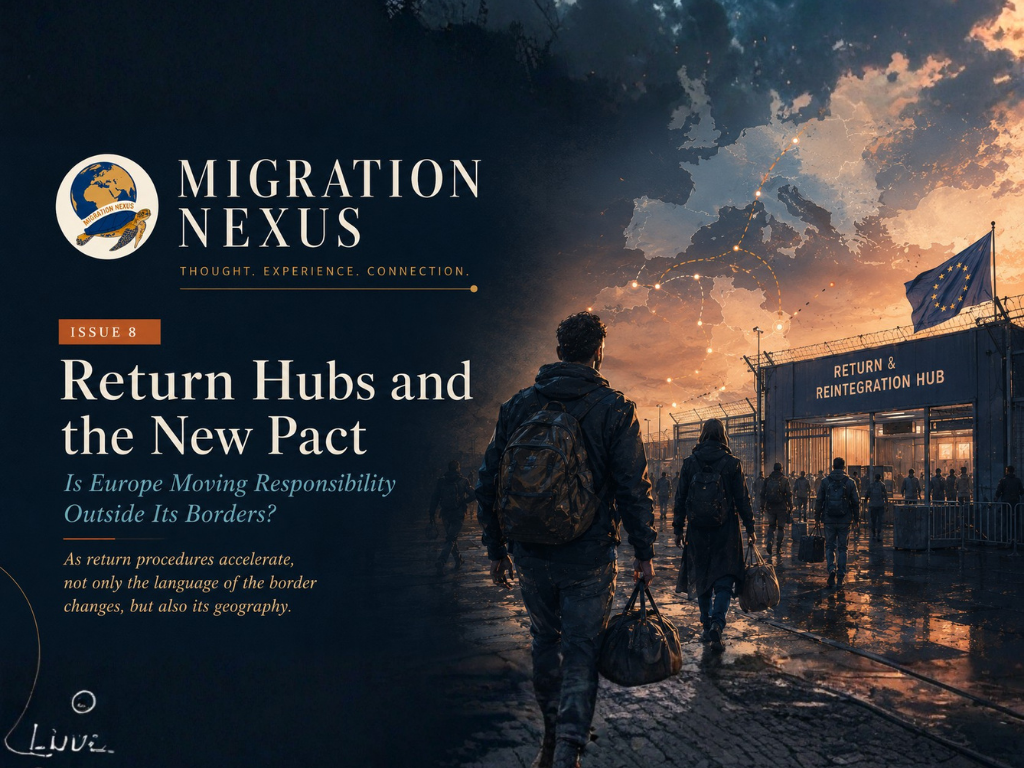
As return procedures accelerate, not only the language of the border changes, but also its geography.
Europe’s migration agenda is currently converging around one axis: faster decisions, faster returns, and greater control. On 12 June 2026, the EU Pact on Migration and Asylum entered into application; the Commission presented it as a comprehensive transformation of the EU’s migration and asylum system. The new framework brings together common screening and registration at the border, accelerated asylum and return procedures, responsibility rules, and a solidarity mechanism under one package (European Commission, 2026a). What is being discussed is no longer a draft, but a new regime that has begun to operate at the border and within administrative procedures.
The most striking aspect of this regime is not only what it accelerates, but also what it relocates. On 1 June 2026, negotiators from the Council and the European Parliament reached a provisional agreement on a new regulation designed to accelerate the return of third-country nationals who do not have the right to stay in the EU. The Council frames this regulation as a tool that will make the return of people in an irregular status in Member States faster and more effective, while complementing the implementation of the Pact on Migration and Asylum (Council of the European Union, 2026). Effectiveness sits at the centre of this language; yet how effectiveness is measured, through which tools it is pursued, and upon whose bodies it is enacted often remain less visible.
Behind this debate lies the same structural gap. According to Eurostat, in the last quarter of 2025, 117,545 third-country nationals were ordered to leave EU countries, while 33,860 people were actually returned to third countries during the same period (Eurostat, 2026). In other words, a wide gap between decision and enforcement persists. The literature reads this gap not merely as a technical implementation problem, but also as a political ground through which the EU return regime is hardened (Leerkes & Van Houte, 2020; Molnár, 2025). The idea of return hubs gains political appeal precisely through the promise of closing this decision–enforcement gap. Yet the critical issue is not only how this gap will be closed, but what human, legal, and spatial costs will be produced in the process.
A conceptual distinction matters here. Return hubs and offshore asylum processing models are not the same legal instruments. Return hubs are more directly concerned with transferring people who are assessed as having no right to stay in the EU to third countries during the return process; offshore asylum processing, by contrast, may refer to the processing of asylum applications outside EU territory (Montaldo, 2025; Pahladsingh, 2025). Yet both models converge within a common political logic: relocating certain stages of migration management outside EU territory and thereby reconfiguring the geography of responsibility (Marcheva, 2025; Muharremaj & Cami, 2024; Potyomkina, 2025). The issue, therefore, is not merely a new administrative mechanism, but the question of where the border begins and where responsibility ends.
At this point, the debate on return hubs moves to the centre of the agenda. The new regulatory trajectory opens the door for people without the right to stay in the EU to be sent to centres established in third countries; these centres may function either as final destinations or as transfer points to another country (Council of the European Union, 2026; Pahladsingh, 2025). The European Parliament’s step in June 2026 also shows that this trajectory is gaining momentum: Parliament gave political support to a regulation aimed at accelerating returns and making it easier for Member States to establish centres outside the EU (European Parliament, 2026; Reuters, 2026c). Return is thus no longer only a faster administrative procedure; it is becoming a new spatial model of governance that can be set up beyond EU borders.
This shift has a meaning that may appear technical, but is deeply political. When a process takes place within the EU, legal oversight, public scrutiny, appeal mechanisms, and rights advocacy are more visible. When the same process is transferred to centres outside the EU, where responsibility begins and where it ends becomes more ambiguous. This ambiguity is often described as flexibility or effectiveness; in practice, however, it produces grey zones around access to rights, legal remedies, detention conditions, and monitoring mechanisms (Marcheva, 2025; Potyomkina, 2025). The most difficult dimension of externalisation emerges here: political responsibility may remain inside the EU, while legal oversight and effective protection become more fragmented and less traceable in third countries (Ivanov, 2025; Spijkerboer, 2021).
EU institutions defend return hubs and the new return regime together with the language of respect for fundamental rights, international law, and monitoring mechanisms. The European Parliament also states that the new rules will proceed within a framework that respects fundamental rights, international law, the principle of non-refoulement, and the prohibition of collective expulsion (European Parliament, 2026). Yet the real issue is how, by whom, and with what degree of transparency these safeguards will be implemented in third countries. A rights guarantee can remain in the text; whether it is traceable, accessible, and contestable in an externalised centre is a different matter. The literature emphasises that the objective of effectiveness in return policy is in continuous tension with fundamental rights safeguards, and that accelerated procedures in particular may weaken principles such as non-refoulement, procedural guarantees, and human dignity (Boková & Bražina, 2021; Lang & Nagy, 2021; Molnár, 2025; Pahladsingh, 2025).
The risk of refoulement refers to the danger that a person may be sent, directly or indirectly, to a country where they could face persecution, torture, serious harm, or inhuman treatment. This concept shows that return policies cannot be assessed solely through administrative effectiveness. The fact that a decision is made quickly does not mean that it is safe, lawful, or compatible with human dignity. The principle of non-refoulement is one of the most fundamental safeguards limiting return procedures; however, accelerated procedures, the logic of safe third countries, and externalised centres may make the practical application of this safeguard more uncertain (Boková & Bražina, 2021; Lang & Nagy, 2021; Negishi, 2024; Serbest, 2026). Indirect or chain refoulement becomes especially important here: even if a person is not sent directly to a dangerous country, the possibility that they may be pushed onward from the third country to which they are transferred can effectively weaken protection safeguards (Negishi, 2024).
The most disturbing aspect of return hubs begins here: the reduction of a human being from a rights-bearing subject to the category of a returnable person. Dehumanisation here does not operate only through openly hostile language, but also through administrative abstraction: a person is read not through their name, story, or vulnerabilities, but through a file number, status, risk, and capacity for removability. Kuschminder and Dubow’s study on refused Afghan asylum seekers shows that resistance to return is shaped not only by legal or economic reasons, but also by experiences of moral exclusion and dehumanisation (Kuschminder & Dubow, 2022). When a policy language transforms a person first into a file, then into a status, and then into a transportable administrative problem, dehumanisation begins precisely within these technical words.
This is why the warning of UN High Commissioner for Human Rights Volker Türk matters. Türk warned that the new return rules may risk dehumanising migrants and refugees, expanding detention, establishing offshore return hubs, and weakening safeguards against refoulement (Reuters, 2026c). This warning places at the centre of the debate not only how many people will be returned, but also how people are named in the process and from which rights they may be effectively distanced.
Return regimes are often discussed through numbers: how many decisions were issued, how many people were returned, how much faster the process became. Yet dehumanisation often occurs outside the number. A person’s story, fear, legal situation, family ties, health vulnerabilities, or the risks they may face upon return can become blurred within the language of the return case. DeBono’s critique of the presentation of return and deportation as a solution to crisis becomes especially meaningful here: deportation may produce a politically powerful image of solution, but in practice it is often limited, costly, and heavy in its human consequences (DeBono, 2016).
This language sometimes operates not through overt coercion, but through humanitarian or voluntary return discourse. The literature shows that voluntary return and reintegration programmes do not always express a fully free choice; in some cases, they reframe decisions made under legal precarity, deportability, and social pressure within a humanitarian language (Fine & Walters, 2021; Maâ, 2023; Robinson, 2022). Negishi’s concept of constructive refoulement is important here: if a person returns in an apparently voluntary way, but the conditions they face effectively leave them with no real alternative to return, then the basic boundaries of protection law must be reconsidered (Negishi, 2024). For this reason, it is not enough to read return policies only through the distinction between forced and voluntary return; what matters is whether the person truly has a safe and free field of choice.
Recent developments show that the idea of return hubs is rapidly becoming concrete at the level of Member States. According to Reuters’ report dated 10 June 2026, the Greek Parliament adopted a law accelerating the return of rejected asylum seekers and explicitly announced the aim of establishing return hubs outside the EU. The report states that Greece is working on these centres with the Netherlands, Denmark, Germany, and Austria, and is also holding talks with third countries in Africa (Reuters, 2026b). This shows that the debate on return hubs is no longer only a negotiation taking place in Brussels, but has moved into Member States’ domestic law and external diplomatic initiatives.
Here, the logic of externalisation comes into play. Studies on the external dimension of migration governance show that the EU increasingly transfers certain stages of migration management to agreements with third countries, informal arrangements, and flexible cooperation mechanisms in order to expand its control capacity (Niemann & Zaun, 2023; Slominski & Trauner, 2020; Potyomkina, 2025). Such arrangements may provide speed and flexibility; at the same time, they can weaken transparency, judicial oversight, and accountability (Fernando-Gonzalo, 2023; Ivanov, 2025; Slominski & Trauner, 2020; Spijkerboer, 2021). Return hubs can be read as a more hardened form of this externalisation logic: the person is physically held outside the EU, while the political responsibility for the decision remains inside the EU; yet where and how oversight operates becomes uncertain.
The Italy–Albania route is one of the most visible laboratories of this debate. According to the Financial Times, conditional EU-level support has emerged for the centres Italy plans to establish in Albania; however, for this model to be considered compatible with EU law, people must be provided with protection equivalent to that available in Italy (Financial Times, 2026). This point is crucial: if a centre is established outside the EU, the issue is not only its physical location. The real question is whether the person’s legal field of protection is also being moved outside. Studies on the Italy–Albania model show that in centres physically established outside the EU, the relationship between EU law, national jurisdiction, and protection standards does not become easily clear (Montaldo, 2025; Muharremaj & Cami, 2024; Pahladsingh, 2025).
The technical malfunction that occurred on the day the Pact began also reveals the fragility of the new regime. According to Reuters, on 12 June 2026, the day the new system entered into application, a technical malfunction affected Eurodac, the EU’s central asylum database. Eurodac is a critical infrastructure for the functioning of the new system, containing biometric and identity data such as fingerprints and facial images. The same report also conveys concerns that some Member States were not fully prepared for the new procedures and that infrastructure gaps and technical problems remained (Reuters, 2026d). This malfunction may appear to be a small technical issue; in fact, it is a sign of how the new regime will operate: when law, databases, administrative capacity, and border procedures are tied together, a system failure is not merely a technical problem; it can directly affect people’s experiences of waiting, detention, application, and appeal.
For this reason, today’s debate is not simply whether returns are becoming faster. At a deeper level, it is about how Europe sees the human being within migration governance. Is the person an applicant, a rights-bearing subject, someone in need of protection, or an administrative burden to be moved, held, and classified? The language of policy becomes decisive here. Effectiveness, speed, control, and return are not neutral words on their own; they determine who remains visible and who is quietly placed inside a procedure.
Another invisible area is the question of people who cannot be removed. Not every return decision can be enforced in practice; lack of documentation, refusal by the country of origin to readmit the person, security risks, health conditions, or obstacles related to non-refoulement may leave some people in an uncertain status for long periods. Carrera, Pőcze, and Jubany’s comparative study shows that irregularised non-removable third-country nationals are left in legal and social limbo in many Member States, creating serious problems for access to basic services, human dignity, and long-term integration (Carrera et al., 2025). Measuring the success of return policy only by the number of people returned therefore renders invisible the legal uncertainty experienced by those who cannot be removed.
The political appeal of this transformation is clear. It sends a strong message to the public: the system is under control, decisions are accelerating, returns will increase. Yet the invisible side of this message may be heavier. More detention, weaker appeal mechanisms, less monitorable centres in third countries, the risk of chain refoulement, shrinking fields of choice under the name of voluntary return, and the definition of the human being only through returnability. Dehumanisation is not always constructed through openly hateful language; sometimes it is constructed within a very technical and very orderly administrative language.
What is being discussed in Europe’s migration agenda today is not only more return. More deeply, the geography of migration governance and the way it defines the human being are changing. Return hubs, the Pact, Eurodac, accelerated procedures, and voluntary return discourse are all parts of the same picture: the border wants to decide earlier, separate faster, and spread responsibility across a wider geography. This is why the critical issue is not only whether Europe is managing migration, but where Europe makes the human and legal costs of this management visible, and where it makes them invisible.
If success is measured only by speed, the system may appear more effective. But if access to rights, the possibility of appeal, detention conditions, non-refoulement assessments, the legal status of non-removable people, and human dignity are not measured, then this success may be nothing more than a better-managed invisibility.
References
Boková, T., & Bražina, R. (2021). Expulsion of aliens, non-refoulement and issues related to administrative discretion. Institutiones Administrationis. https://doi.org/10.54201/iajas.v1i1.11
Carrera, S., Pőcze, J., & Jubany, O. (2025). A point of no return: A comparative analysis of legal and policy responses to irregularised non-removable third-country nationals in selected EU Member States. Open Research Europe. https://doi.org/10.12688/openreseurope.20236.1
Council of the European Union. (2026, June 1). Council and Parliament reach deal on returns of illegally staying third-country nationals. https://www.consilium.europa.eu/en/press/press-releases/2026/06/01/council-and-parliament-reach-deal-on-returns-of-illegally-staying-third-country-nationals/
DeBono, D. (2016). Returning and deporting irregular migrants: Not a solution to the refugee crisis. Human Geography, 9, 101–112. https://doi.org/10.1177/194277861600900210
European Commission. (2026a, June 12). New migration and asylum rules enter into application: What is changing. https://home-affairs.ec.europa.eu/news/new-migration-and-asylum-rules-enter-application-what-changing-2026-06-12_en
European Commission. (2026b). Pact on Migration and Asylum. https://home-affairs.ec.europa.eu/policies/migration-and-asylum/pact-migration-and-asylum_en
European Parliament. (2026, June 18). New EU system for return of illegally staying third country nationals. https://www.europarl.europa.eu/news/en/press-room/20260611IPR45214/new-eu-system-for-return-of-illegally-staying-third-country-nationals
Eurostat. (2026, March 31). Returns to third countries up by 13% in Q4 2025. https://ec.europa.eu/eurostat/web/products-eurostat-news/w/ddn-20260331-1
Fernando-Gonzalo, E. (2023). The EU’s informal readmission agreements with third countries on migration: Effectiveness over principles? European Journal of Migration and Law. https://doi.org/10.1163/15718166-12340145
Financial Times. (2026, June 11). Giorgia Meloni wins conditional EU backing for Albania asylum centres. https://www.ft.com/content/abf66fc7-f8d4-4329-b341-09e35df3033f?syn-25a6b1a6=1
Fine, S., & Walters, W. (2021). No place like home? The International Organization for Migration and the new political imaginary of deportation. Journal of Ethnic and Migration Studies, 48, 3060–3077. https://doi.org/10.1080/1369183X.2021.1984218
Ivanov, D. (2025). Modern trends in international legal regulation of forced migration: Externalization of international protection. Moscow Journal of International Law. https://doi.org/10.24833/0869-0049-2025-4-6-23
Kuschminder, K., & Dubow, T. (2022). Moral exclusion, dehumanisation, and continued resistance to return: Experiences of refused Afghan asylum seekers in the Netherlands. Geopolitics, 28, 1057–1078. https://doi.org/10.1080/14650045.2022.2055462
Lang, I. G., & Nagy, B. (2021). External border control techniques in the EU as a challenge to the principle of non-refoulement. European Constitutional Law Review, 17, 442–470. https://doi.org/10.1017/S1574019621000249
Leerkes, A., & Van Houte, M. (2020). Beyond the deportation regime: Differential state interests and capacities in dealing with (non-)deportability in Europe. Citizenship Studies, 24, 319–338. https://doi.org/10.1080/13621025.2020.1718349
Maâ, A. (2023). Autonomy of migration in the light of deportation: Ethnographic and theoretical accounts of entangled appropriations of voluntary returns from Morocco. Environment and Planning D: Society and Space, 41, 92–109. https://doi.org/10.1177/02637758221140885
Marcheva, D. (2025). The external components in the EU comprehensive approach to migration and asylum: A pathway to lawless zones. European Journal of Migration and Law. https://doi.org/10.1163/15718166-12340211
Molnár, T. (2025). The European Union, expulsion of aliens and the Return Directive: A repressive or protective framework? Griffith Law Review, 34, 360–381. https://doi.org/10.1080/10383441.2025.2507461
Montaldo, S. (2025). Not in my backyard! Outsourcing EU asylum procedures to third countries: A challenge for the Common European Asylum System. Common Market Law Review. https://doi.org/10.54648/COLA2025023
Muharremaj, E., & Cami, G. (2024). The externalization of the European Union migration and asylum policy: A case study of the Italy-Albania agreement. International Organisations Research Journal. https://doi.org/10.17323/1996-7845-2024-04-03
Negishi, Y. (2024). Constructive refoulement as disguised voluntary return: The internalised externalisation of migrants. Netherlands International Law Review, 71, 155–176. https://doi.org/10.1007/s40802-024-00256-6
Niemann, A., & Zaun, N. (2023). Introduction: EU external migration policy and EU migration governance. Journal of Ethnic and Migration Studies, 49(12), 2965–2985. https://doi.org/10.1080/1369183X.2023.2193710
Pahladsingh, A. (2025). Proposal of the European Commission for a Return Regulation: Balancing effective return policy and fundamental rights protection of the migrant. ERA Forum, 26, 487–508. https://doi.org/10.1007/s12027-025-00854-8
Potyomkina, O. (2025). New trends in the external dimension of EU migration and asylum policy. World Economy and International Relations. https://doi.org/10.20542/0131-2227-2025-69-5-44-54
Reuters. (2026a, June 1). EU paves way to allow migrant deportations to centres outside bloc. https://www.reuters.com/world/european-union-reaches-deal-fast-track-illegal-migrant-returns-2026-06-01/
Reuters. (2026b, June 10). Greece approves quicker migrant returns, aims to set up return hubs. https://www.reuters.com/world/greece-approves-quicker-migrant-returns-aims-set-up-return-hubs-2026-06-10/
Reuters. (2026c, June 17). EU Parliament backs law allowing offshore detention centres. https://www.reuters.com/world/eu-parliament-backs-law-allowing-offshore-detention-centres-2026-06-17/
Reuters. (2026d, June 12). EU asylum database malfunctions on migration pact launch day. https://www.reuters.com/world/eu-asylum-database-malfunctions-migration-pact-launch-day-2026-06-12/
Robinson, C. (2022). Deportability, humanitarianism and development: Neoliberal deportation and the Global Assistance for Irregular Migrants program. Third World Quarterly, 43, 879–897. https://doi.org/10.1080/01436597.2022.2038128
Serbest, F. B. F. (2026). The reshaping of the safe third country approach under the EU Pact on Migration and Asylum: Türkiye’s position and normative implications (2024–2026). Journal of Migration and Political Studies. https://doi.org/10.69510/mipos.1869032
Slominski, P., & Trauner, F. (2020). Reforming me softly: How soft law has changed EU return policy since the migration crisis. West European Politics, 44(1), 93–113. https://doi.org/10.1080/01402382.2020.1745500
Spijkerboer, T. (2021). Migration management clientelism. Journal of Ethnic and Migration Studies, 48, 2892–2907. https://doi.org/10.1080/1369183X.2021.1972567